Showing posts with label beauty. Show all posts

Thursday, January 9, 2014

The Ragged Schools of Scotland: A Dickensian Dream fulfilled

by Megan Hoyt

Thomas Guthrie's "Ragged Theology" was a new concept in 1800s Scotland, but we see glimpses of it throughout Charlotte Mason's writings. Did you know that? I didn't -- until a couple of weeks ago when I fell in love with Ragged Schools! Gentle whispers throughout the pages of each of Miss Mason's volumes woo us toward magnanimous thinking, toward proffering ideas to children instead of speed drills, toward seeing the infinite value of a human being instead of his utility to the state. 

Miss Mason believed every living soul deserved to access the great minds of the past -- the great art, music, literature, inventions, poetry, and all the glorious ideas that came before them.  But just prior to the time she began saying such things, Thomas Guthrie and Andrew Walker were heading into Edinburgh's slums to offer the Gospel to those who thought themselves beyond reach, who others didn't even bother with -- the nameless, faceless poor. Guthrie wrote about one man's response to the Gospel in his autobiography. What a beautiful recognition this gentleman had! May we all have such tender souls as this grace-filled man!

"He rose, bowed down by a sense of sin, in great distress of mind; he would go to the church that day, but being a man of a very tender conscience, he hesitated about going to the Lords table; deep was answering to deep at the noise of God's waterspouts, and all God's billows and waves were going over him; he was walking in darkness, and had no light.  In this state he proceeded to put himself in order for church, and while washing his hands, one by one, he heard a voice say, 'Cannot I, in my blood, as easily wash your soul, as that water wash your hands?' 'Now Minister,' he said, in telling me this, 'I do not say there was a real voice, yet I heard it very distinctly, word for word, as you now hear me.  I felt a load taken off my mind, and went to the Table and sat under Christ's shadow with great delight.' " (Thomas Guthrie, Memoir and Autobiography, 1896, p 115.)  

Once I began reading about Ragged Schools, the idea clung to my heart. I hope one day to bring some level of hope to America's struggling poor, the way Andrew Walker did in Scotland: 

Obituary:    
London City Mission Magazine  
for May 1, 1896

We have received intelligence also of the death of another servant of Christ, who at one time did earnest effective work as a London City Missionary. A gentleman in Edinburgh writes:-

On the 3rd of February there died at City Troy, New York State, at the patriarchal age of eighty-nine, Mr. Andrew Walker, well known fifty years ago as the pioneer of the Ragged Schools in Westminster.

He was born at Craigsford, Earlston, a pretty village in Berwickshire, July 20th, 1807, and partly educated in the village at the same school which the famous Dr. Waugh, of Wells Street, London, had attended half a century before.

When the time came for choosing a calling, he became, like Robert Moffat, a gardener. His first engagement was at Newton Don, his last in Scotland at Camperdown . . . From Camperdown he went to Hans Place, London. Wandering one day through the narrow lanes and courts of Westminster that lay to the south of the Abbey, he was so impressed with the signs of vice and misery all around him, than he resolved he would make it his life’s work to do what he could to bring light and liberty to the region.

He gave up his occupation at Chelsea, entered the London City Mission, November, 1838, and began his work within the district bounded by Clare Street, Orchard Street, Strutton Ground, and Great Peter Street.

Mr. Walker remained there for fourteen years, and during that time, by the blessing of God on his labours, effected a most remarkable change in the inhabitants. When he went there were six public-houses, one of them having a thieves’ training school attached to it, after the manner of that described by Dickens in “Oliver Twist.”

His first place of meeting was in an old stable . . . By the kindness of Lady Trowbridge, part of it was fitted up for girls. Lady Hope provided sixty of the children with articles of clothing. On the opening day many titled people were there, and Robert Moffat - home on furlough - addressed the children.

Mr. Walker was not long in finding out that any benefit given during school hours was neutralised by the scenes of home life. It was, therefore, decided to retain the young people there night as well as day and provide them with food and clothing - in short, to form a Ragged School, the first of the kind in Westminster. In this he was greatly assisted by Lord Shaftesbury - then Lord Ashley - who, by public speech and private influence, was the means of exciting interest and raising money. Mr. Walker’s next step was to secure the interest of the thieves in his Mission. The district was one of the headquarters of the “swell mob.” These he sought to influence, and accomplished it in this way. Securing a place of meeting in the upper room of one of the public-houses, he accosted some of them one day when they were playing “pitch-and-toss,” and invited them to form a Sunday afternoon class, to which none but those of their own fraternity would be admitted. They agreed, and next Sunday met for an hour in the afternoon for singing, prayer, reading, and explaining God’s Word.

Mr. Walker had many visits from those interested in reclamation work. In his journal he mentions meeting Charles Dickens and taking him round the district. The result of the visit was a powerful article in Household Words, entitled “The Devil’s Acre.” Another visitor was William Chambers, who came introduced by Lord Kinnaird, a warm friend of Mr. Walker’s. This visit was also followed by a paper which appeared in Chambers’  Journal, under the heading “A Visit to Westminster, but not to the Abbey.” His final scheme was to secure another of the public-houses, known as “The Green Man.” It also was fitted up as a Refuge, where trades of various kinds were carried on. Secular education was given during the week and, by the assistance of various ladies and gentlemen, Sabbath instruction also.

In due time the lads passed into the world to earn an honourable living, many of them going to Australia and the States.

After this arduous labour in Westminster, Mr. Walker removed to the Surrey side of the river and began the Wellington Nursery for the reclamation of the wanderers, where education and out-door occupation were combined. Here he was again visited by Charles Dickens, who penned another graphic article in Household Words, called “Tilling the Devil’s Acre.” Acting under medical advice he gave up this work in 1858, sailed for the States, and settled down in Troy City, where he became an active worker and elder in the United Presbyterian Church, carrying on his first occupation.

From Thomas Chalmers to Thomas Guthrie to Andrew Walker to the London City Mission of today, Charlotte Mason's revolutionary ideas about personhood and education must surely have been influenced by these few kindly gentlemen who looked and really saw, who cared and actually did something to help the less fortunate poor of their day. God bless them! 


Friday, March 15, 2013

Nourishing a Life: Parents as Inspirers

by Megan Hoyt


http://www.sugme.com/children-health/6benefits-children-will-get-from-regular-activities.html
What is our job as parents when it comes to education? Charlotte Mason answers:

"Our last paper closed with an imperfect summary of what we may call the educational functions of parents. We found that it rests with the parents of the child to settle for the future man his ways of thinking, behaving, feeling, acting; his disposition, his particular talent; the manner of things upon which his thoughts shall run. Who shall fix limitations to the power of parents? The destiny of the child is ruled by his parents, because they have the virgin soil all to themselves. The first sowing must be at their hands, or at the hands of such as they choose to depute." (Parents' Review, Volume 2, no. 2, 1891/92, pg. 38, "Parents as Inspirers")

Oh dear.

"...it rests with the parents of the child to settle for the future man his ways of thinking, behaving, feeling, acting; his disposition, his particular talent; the manner of things upon which his thoughts shall run."

"The destiny of the child is ruled by his parents, because they have the virgin soil all to themselves."

Um. Well. That's sort of a decently frightening amount of power to be invested in two people whose sole wish at the birth of their first child was that an owner's manual might be tied to his toe! Good grief! What are we to do?

My grandson Anthony Gabriel
I think she sums things up nicely here:   

"They [ideas that lead to right living] are not to be given of set purpose, nor taken at set times. They are held in that thought-environment which surrounds the child as an atmosphere, which he breathes as his breath of life; and this atmosphere in which the child inspires his unconscious ideas of right living emanates from his parents. Every look of gentleness and tone of reverence, every word of kindness and act of help, passes into the thought-environment, the very atmosphere which the child breathes; he does not think of these things, may never think of them, but all his life long they excite that 'vague appetency towards something' out of which most of his actions spring. Oh, wonderful and dreadful presence of the little child in the midst!"

So that's it. We provide the atmosphere. We behave in certain ways, and they "catch" the vision without knowing it. This explains why my children love opera and hate sports. But there's so much more to this. What about those gravely important and desperately cherished values we want to pass on to our children? And how do we handle this overwhelming and awesome responsibility of raising children toward their destinies? What do we do to and for this virgin soil of theirs? The answers are sometimes contradictory, as evidenced by all the various parenting books and websites and blogs, but here are a few I really like:

"The long-range vision of Attachment Parenting is to raise children who will become adults with a highly developed capacity for empathy and connection."

http://knowinggarden.org/parenting-pearls/


And here are a few I don't like very much at all (read: hate):

 Train Up a Child
(Read a few of the comments at the bottom to get an idea of what this type of parenting is about.)
Growing Kids God's Way

It's not that I don't believe in disciplining children who are not obeying the family rules. I do. I really, really do. But despite what these "spare the rod, spoil the child" parenting books have to say on the matter, when we only get at the outward acquiescence of a child with his "yes, sir" and "yes, ma'am," (to avoid punishment) and we don't ever reach the heart of a child with all the wonder of the universe and the great and glorious God who rules over it and their duty to obey Him out of a deep and profound love for Him, we have missed the mark in our educational duties as parents in my opinion. Our duty, according to Charlotte Mason, is much deeper than to achieve the outward cleanliness of training the child's faculties for obedience to the masters (us).

"Thus we see how the destiny of a life is shaped in the nursery, by the reverent naming of the Divine Name; by the light scoff at holy things; by the thought of duty the little child gets who is made to finish conscientiously his little task; by the hardness of heart that comes to the child who hears the faults or sorrows of others spoken of lightly." (Parents' Review, pg. 38.)

I'll let her explain it further to you:

"an idea is not an 'instrument,' but an agent; is not to be 'handled,' but, shall we say, set in motion? We have perhaps got over the educational misconception of the tabula rasa. ... Here it is in its cruder form: 'Pestalozzi aimed more at harmoniously developing the faculties than at making use of them for the acquirement of knowledge; he sought to prepare the vase rather than to fill it.' In the hands of Froebel the figure gains in boldness and beauty: It is no longer a mere vase to be shaped under the potter's fingers; but a flower, say a perfect rose, to be delicately and consciously and methodically moulded, petal by petal, curve and curl; for the perfume and living glory of the flower, why these will come; do you your part and mould the several petals; wait, too, upon sunshine and shower, give space and place for your blossom to expand. And so we go to work with a touch to "Imagination" here, and to "Judgment" there; now to the "Perceptive faculties," now to the "conceptive;" in this, aiming at the moral, and in this, at the intellectual nature of the child; touching into being, petal by petal, the flower of a perfect life under the genial influence of sunny looks and happy moods. This reading of the meaning of education and of the work of the educator is very fascinating, and it calls forth singular zeal and self-devotion on the part of those gardeners whose plants are the children." (Parents' Review, pg. 38.)

Dad and me
Even though that example of the flower is beautiful, and even though Froebel was someone Miss Mason admired, I still don't think she quite believes in this whole idea of fussing over the child, flower or not. She's saying children are not vases waiting to be filled. Nor is our duty to prepare the vase so it will be more receptive to filling. It's not even to prepare the flower by delicately molding and shaping it with a touch here and a touch there, although that's closer to her ideas than Pestalozzi came. But still, there's this dreadful fear that all children will be more or less replicas of their parents or of each other if we all follow the exact same molding and fussing to make them into the image we believe will be beautiful. And who's to say that our idea of beautiful is the right one? And anyway, is that really our duty as parents? To make our children into the images we want for them? I don't know about you, but whenever someone used to say, "she's the spitting image of her father!" I cringed. I didn't want to be the spitting image of my dad! For one thing, he had a gigantic nose, wore thick glasses, and was mostly bald. But looks aside, he was bold and loud and I was quiet and pensive. Now imagine for a moment what beauty looks like to the bold, loud parent and what it looks like to the tender, delicate child. My parents would have made me into someone totally different than what my heavenly Father had in mind when He intricately designed me! Is that what Miss Mason means for us to accomplish when she says, "...it rests with the parents of the child to settle for the future man his ways of thinking, behaving, feeling, acting; his disposition, his particular talent; the manner of things upon which his thoughts shall run." Does she want us to make our children into who we believe they should be? I don't think so. Isn't there a better way to draw out the positive attributes and leave behind the negative ones than to fawn over our kids and constantly pick and peck at them until they look like what we want them to look like? Even in positive ways? Absolutely!

Charlotte Mason tells us self education is the best education. But it's our job to be their guide and to oversee the journey. We do that by offering a luscious feast of living ideas to them, carefully chosen by US to display the glory and wonder of the living God. That doesn't mean we leave out important scientific discoveries because they appear to prove evolution is true or that we don't tell our children about all the evil in the world or all the starving children or teach them to take action against the sex trade industry and pray for the wisdom of our nation's leaders despite their support of despicable things that we abhor like abortion on demand. We're in this world. But as Christians, we are not OF this world. We occupy, not Wall Street, but our place within the sovereign will and plan of our Lord. So we guide our children toward accepting that awesome responsibility, toward listening to God and hearing the voice of the Holy Spirit and effortlessly serving and loving and giving while being shrewd and putting forth large amounts of academic effort because it's our duty toward God, man, and country. These are the "unconscious ideas of right living that emanate from us as parents." And they're caught, not taught. Relieved? Don't be. It's even tougher to exemplify Christ than it is to teach about Him, don't you think? Thank goodness we have the Holy Spirit dwelling within us, quickening our hearts to behave rightly and to show our children the higher path.
 

Hannah, Drew, and Jesse
The next portion of "Parents as Inspirers" says:

"How much is there in this pleasing and easy doctrine that the drawing forth and strengthening and directing of the several "faculties" is education? Parents are very jealous over the individuality of their children; they mistrust the tendency to develop all on the same plan; and this instinctive jealousy is right; for, supposing that education really did consist in systematised efforts to draw out every power that is in us, why, we should all develop on the same lines, be as like as "two peas," and (should we not?) die of weariness of one another! Some of us have an uneasy sense that things are tending towards this deadly sameness. But, indeed, the fear is groundless. We may believe that the personality, the individuality of each of us is too dear to God, and too necessary to a complete humanity, to be left at the mercy of empires. We are absolutely safe, and the tenderest child is fortified against a battering-ram of educational forces." (Parents' Review, pg. 38.)

I think she's saying that God won't allow educational systems to go so far as to shipwreck the personalities and individuality of children. That's a comforting thought, really. But I have to admit that I don't have quite that much faith. I believe it IS possible for educational systems to shipwreck our children in a variety of ways, especially to shipwreck their faith in God and indoctrinate them with morals and values that are less than stellar. If only poor Charlotte knew what we are facing today. Check out Nathan Harden's article in Imprimis, Hillsdale College's monthly newsletter, if you don't realize what's happening  at our nation's institutes of higher learning: 

There is clearly a radical sexual agenda at work at Yale today. Professors and administrators who came of age during the sexual revolution are busily indoctrinating students into a culture of promiscuity. In fact, Yale pioneered the hosting of a campus “Sex Week”—a festival of sleaze, porn, and debauchery, dressed up as sex education. I encountered this tawdry tradition as an undergrad, and my book documents the events of Sex Week, including the screening in classrooms of hard-core pornography and the giving of permission to sex toy manufacturers and porn production companies to market their products to students.

In one classroom, a porn star stripped down to bare breasts, attached pinching and binding devices to herself as a lesson in sadomasochism, and led a student around the room in handcuffs. On other occasions, female students competed in a porn star look-alike contest judged by a male porn producer, and a porn film showing a woman bound and beaten was screened in the context of “instruction” on how students might engage in relationships of their own.

And again, these things happened with the full knowledge and approval of Yale’s senior administrators.

As might be expected, many Yale students were offended by Sex Week, but university officials defended it in the name of “academic freedom”—a sign of how far this noble idea, originally meant to protect the pursuit of truth, has fallen. And the fact that Yale as an institution no longer understands the substantive meaning of academic freedom—which requires the ability to distinguish art from pornography, not to mention right from wrong—is a sign of its enslavement to the ideology of moral relativism, which denies any objective truth (except, of course, for the truth that there is no truth). 

(http://www.hillsdale.edu/news/imprimis/archive/issue.asp?year=2013&month=01)

Yes, it's disgusting, but God has provided the antidote! The following video clip is long, but I had to include it because as I was writing this blog post about the winding ascent and going higher up and further in, I heard Heidi say in the background on this video, "He will lead you higher up and further down." I asked God what she meant by that and listened to it again and discovered she was talking about going into dark places with the light we have and shining brightly. So another of our duties is to prepare our children to enter these dark places and not allow their lights to be doused by the wickedness and worldliness they'll soon encounter. Since I am in the throes of raising teenagers and not young children, this is all the more real to me, but those with toddlers and preschoolers can start invigorating their faith now, while they're still in the nursery, as Miss Mason advises. 


Miss Mason says, "We are absolutely safe, and the tenderest child is fortified against a battering-ram of educational forces." While that may have been true in the early twentieth century, I'm not so convinced it's still true in the twenty-first. But God is fully alive and capable of turning all of this around. And He may just have US in mind as the vehicles through which a gentle shift in educational theory will be accomplished, so keep your minds and hearts (and ears) open to His call. The college professors of the future are in our care today. How we nourish and inspire the children within our care can have an enormous impact on the future of American society. It's no small thing. Not in the least.

 "The problem of education is more complex than it seems at first sight, and well for us and the world that it is so. "Education is a life;" you may stunt and starve and kill, or you may cherish and sustain; but the beating of the heart, the movement of the lungs, and the development of the faculties (are there any "faculties"?) are only indirectly our care. The poverty of our thought on the subject of education is shown by the fact that we have no word which at all implies the sustaining of a life: education (e, out, and ducere, to lead, to draw) is very inadequate; it covers no more than those occasional gymnastics of the mind which correspond with those by which the limbs are trained; training (trahere) is almost synonymous, and upon these two words rests the misconception that the development and the exercise of the "faculties" is the object of education (we must needs use the word for want of a better. Our homely Saxon "bringing up" is nearer the truth, perhaps because of its very vagueness; anyway, "up" implies an aim, and "bringing up" an effort." (Parents' Review, pg. 38.)

Yes! The winding ascent. The striving ever upward, further up and further in, reaching for the higher goal. That is my aim. I may not be able to do much more than lead by example at this point with only a 16-year-old watching, but that's one thing I can still do. And be present to answer any and all questions. Hopefully, the early years will bring forth a harvest of curiosity and a quest for truth that will last for years to come.

I'll leave you with these last few quotes. Ponder them. Ingest them. Let them sink into the depths of your heart. To me, this is the real purpose of parenting and education. 

"It rests with parents not only to give their children birth into the life of intelligence and moral power, but to sustain the higher life which they have borne. Now that life, which we call education, receives only one kind of sustenance; it grows up on ideas. You may go through years of so-called "education" without getting a single vital idea; and this is why many a well-fed body carries about a feeble, starved intelligence, and no society for the prevention of cruelty for children cries shame on the parents." (Parents' Review, pg. 38.)

"Every study, every line of thought, has its 'guiding idea;' therefore, the study of a child makes for living education, as it is quickened by the guiding idea 'which stands at the head.' " (Parents' Review, pg. 38.)


"Ideas may invest, as an atmosphere, rather than strike as a weapon. 'The idea may exist in a clear, distinct, definite form, as that of a circle in the mind of a geometrician; or it may be a mere instinct, a vague appetency towards something,... like the impulse which fills the young poet's eyes with tears, he knows not why.' To excite this 'appetency towards something'--towards things lovely, honest, and of good report, is the earliest and most important ministry of the educator. How shall these indefinite ideas which manifest themselves in appetency be imparted? They are not to be given of set purpose, nor taken at set times. They are held in that thought-environment which surrounds the child as an atmosphere, which he breathes as his breath of life; and this atmosphere in which the child inspires his unconscious ideas of right living emanates from his parents. (Parents' Review, pg. 38.)

"There is no way of escape for parents; they must needs be as 'inspirers' to their children, because about them hangs, as its atmosphere about a planet the thought-environment of the child, from which he derives those enduring ideas which express themselves as a life-long 'appetency' towards things sordid or things lovely, things earthly or divine." (Parents' Review, pg. 38.)

"The whole subject is profound, but as practical as it is profound. We must disabuse our minds of the theory that the functions of education are, in the main, gymnastic. In the early years of the child's life it makes, perhaps, little apparent difference whether his parents start with the notion that to educate is to fill a receptacle, inscribe a tablet, mould plastic matter, or, nourish a life; but in the end we shall find that only those ideas which have fed his life are taken into the being of the child; all the rest is thrown away, or worse, is like sawdust in the system, an impediment and an injury to the vital processes." (Parents' Review, pg. 38.)


I'm not a child anymore;
I'm tall enough
To reach for the stars.
Your hands held mine so few hours,
And I'm not a child anymore.

Thursday, January 31, 2013

Children are born persons. So what?

 by Megan Hoyt


The value of a child. I know I touched on this subject in an earlier blog post, but personhood is absolutely crucial to any true understanding of the Charlotte Mason method. So I'm coming around the mountain again, hopefully a teensy bit higher up and further in this time around.


Children are born -- not lizards or apes or giant sloths or butterflies or leopards or zebras. Children are born persons. But just what does that really mean? 

First, let me admit I'm still not completely sure. I suspect it has to do with value, ability of mind, and potential (see volume 6, chapter 2).

But here's something I've been pondering. What is my obligation as a teacher and a parent toward producing within my students a heart that values others as born persons? I'm probably duty bound to hone and inspire all sorts of positive character traits within their precious, malleable hearts, right? That's what the local school administrators say, anyway. They focus on a different trait each month. I've seen it on the marquees out front. Students earn awards for being the most helpful, generous, or kindhearted kid in school. Is this how we teach children to treat one another like persons -- by rewarding them with stickers and trophies when they are nice to one another? Where does that leave the kid whose natural willfulness has not quite been knocked out of him yet on the "value" chart? I can hear his negative self talk beginning even now. (Check out Creep by Radiohead for where he'll end up later in life.)

And while we're on the topic of positive attributes, is being kind more important than being thrifty? Being honest more important than being humble? The lines are rather fine and delicate, and I don't know which ones to place near the top of my behaviorism chart (sarcasm). We can all agree that producing the fruit of the spirit (love, joy, peace, kindness, long-suffering, goodness, self control) is a good idea. But Charlotte Mason doesn't advise us to "produce" anything. Our job is to present ideas, then step out of the way. This task of valuing each child coupled with the daunting task of teaching them to value others seems overwhelming to me.


It all seems to go back to the single question of personhood. We value being good and noble and magnanimous because each one of us is created in the image of God, the Creator of the universe, and thus deserves to be treated with respect, dignity, and kindness. We are valuable because we are persons.


Valuable just for being human? Hmmm.


Can't I evaluate the worth of a human being? Can I grab my jeweler's loupe and take a closer look before I pronounce value upon a child? I'm not so sure we don't do that every day we enter the classroom -- without realizing it of course!


Is "worth" even something we should evaluate? Would it be morally superior to accept that every person is of great value simply because of our shared humanity and leave it at that? But then we have the sticky business of believing Hitler and Osama bin Laden were of equal worth to Mother Teresa and Ghandi. I'm not sure I can rationalize that. 


Does it matter whether or not we do what is morally superior anyway? How do we determine right thinking from wrong thinking? Morally, ethically superior thoughts and beliefs from those that are inferior? Who gets to decide? Have you ever witnessed someone get a tongue-lashing -- maybe a department store clerk or a cashier? Have you ever been the one to dole out the tongue lashing? They deserved to be ill-treated because they opened up a new checkout line and took the guy behind you instead of you. Where does the "he deserved it" stop and the "Because I value you as a person, I am not going to criticize, ridicule, or shame you" begin? Can we train ourselves to respect even those we deem unworthy of respect? Are we always right in our accusations anyway? After all, we can't walk in that other fellow's shoes to find out if his heart's motive was to cause us harm or if he just didn't notice we were next in line at the checkout.

And how do we teach children to evaluate their decisions and beliefs based on ethical guiding principles? Can we do that without bringing faith in God or a belief in a higher power into the mix? Should we even try?


These were the questions swirling through my mind this morning after a long week of soul-searching and prayer. It all started on the 40th anniversary of the Roe v. Wade Supreme Court decision that, via the mechanism of "privacy," created an avenue for abortion on demand to be legally acceptable. As I watched friends prepare to go to the March for Life in Washington, DC, and exercise their right to peaceful assembly, and as I read through social media of the many and varied types of people who attended the March, from feminists, pagans and homosexuals to ultra conservative Catholics and evangelicals, my heart was stirred. Personhood was inspiring people to come together, to drive long distances in frigid weather and stand firmly in favor of affirming life. It moved me.


What makes a person uniquely valuable, inherently of great worth even as pre-born infants? It's our shared humanity -- that spark within that shines out through our words and deeds and yet is present from conception, perfectly packaged and waiting for life to proceed. We're like little acorns, holding within us all the potential to become sturdy trees, with leaves outstretched to the sun and roots grasping and gulping for nutrition within the shadowy soil. Hitler and bin Laden had that same potential we all have. That's how I can equalize the value of every human being and still include these two. It's what happened as they experienced life that twisted them into a contorted mess.


Newly opened acorn
And that's where we come in.

Charlotte Mason said, "Who shall measure the range of a child's thoughts? His continual questions about God, his speculations about 'Jesus,' are they no more than idle curiosity, or are they symptoms of a God-hunger with which we are all born, and is a child able to comprehend as much of the infinite and the unseen as are his self-complacent elders?" If young children ARE born able to hunger for God, to reflect and meditate on ideas, then perhaps our limited forms of education in the early years need to be turned on their heads or at least rethought. Children are image-bearers of God. Human beings with souls. The acorn bursts open, roots seize at the earth, digging ferociously for nutrition, gasping breathlessly for water. And what that child, newly formed and hungry, finds on his desperate quest is of the utmost importance.

And we are their guides.


As teachers, moms and dads, friends, sisters and brothers, grandparents, and human beings, we have a holy responsibility toward our fellow man, woman, and child. We are obligated by our faith in God and compelled by our belief in the ethical treatment of others to value every child as a "born person," with all the gifts and talents buried within them that God and genetics have granted them. What a serious task is set before us! We can make or break a person with our words and actions. This is quite a strong power God has granted to us, this ability to use words and deeds to help form a child's view of the world (or to hinder it greatly). There really should be a warning label on this gift! "Handle with care. Brutality will render children psychologically crippled. Kindness will raise children to heights previously unknown."


I like my friend Leslie's modern paraphrase of Charlotte Mason's views on the matter: Children are born persons - they are not blank slates or embryonic oysters who have the potential of becoming persons. They already are persons. As Miss Mason says, "...the most prosaic of us comes across evidence of mind in children, and of mind astonishingly alert." We might say, "Children are born thinkers." And what are they to think about?


Velasquez' Sibyl with Tabula Rasa (blank slate)
"Finally, brethren, whatever things are true, whatever things are noble, whatever things are just, whatever things are pure, whatever things are lovely, whatever things are of good report, if there is any virtue and if there is anything praiseworthy—think on these things." (Philippians 4:8)


We are not embryonic oysters! All the potential for great and high living is within every child.
"I am anxious to bring before teachers the fact that a child comes into their hands with a mind of amazing potentialities..." (vol 6, p. 38) We can either draw this tremendous potential out of our students gently, with guiding principles from Miss Mason or we can bore them to death with endless pablum-filled, regurgitated lectures. We can offer them well-written living books that spark creativity, depth of thought and feeling, and compel them to read further by inspiring their curiosity. Or we can force textbooks down their throats and give them heartburn, both literal and figurative. I'm not talking here about spoon-feeding children morals and ethics or forcing them to read stories with obvious moral themes in an effort to channel their thoughts into some sort of stilted morality -- all because we're afraid they won't value others as born persons when they grow up. We instead need to create educational paths for them to stroll down that instinctively form them into Valjeans rather than Javerts. We need to get to their hearts by whatever means possible, to challenge them to think, perceive, intuit, sense, learn, judge, and evaluate -- all while making sure we are not "preaching" to them. Tough job, eh? Not if we remember that our job is to give them ideas, then step out of the way as they grapple with them:


Charlotte Mason Community Co-op study of Michelangelo


"Education, like faith, is the evidence of things not seen. We must begin with the notion that the business of the body is to grow; and it grows upon food, which food is composed of living cells, each a perfect life in itself. In like manner, though all analogies are misleading and inadequate, the only fit sustenance for the mind is ideas, and an idea too, like the single cell of cellular tissue, appears to go through the stages and functions of a life.


Olivia remembers how to make Jacob's Ladder


We receive it with appetite and some stir of interest. It appears to feed in a curious way. We hear of a new patent cure for the mind or the body, of the new thought of some poet, the new notion of a school of painters; we take in, accept, the idea and for days after every book we read, every person we talk with brings food to the newly entertained notion.

'Not proven,' will be the verdict of the casual reader; but if he watch the behavior of his own mind towards any of the ideas 'in the air,' he will find that some such process as I have described takes place; and this process must be considered carefully in the education of children. We may not take things casually as we have done. Our business is to give children the great ideas of life, of religion, history, science; but it is the ideas we must give, clothed upon with facts as they occur, and must leave the child to deal with these as he chooses." (vol 6, pp 39-40)


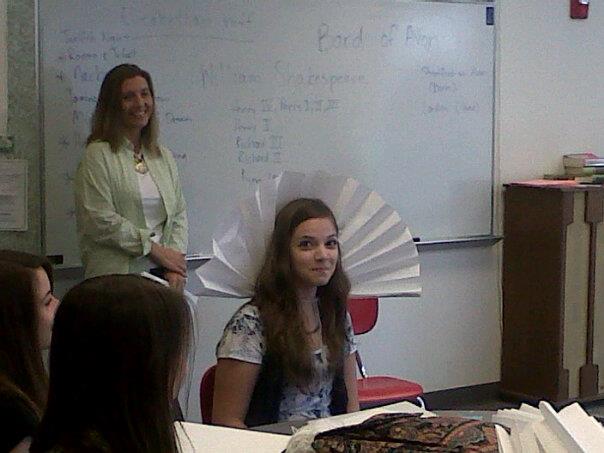
Hannah makes an Elizabethan collar
Take a look at the fruit of presenting living ideas to our children, especially those that provide an ethics framework for them:

This is how he [the poet Thomas Traherne] deals with Geography, for example:––


"When I heard of any new kingdom beyond the seas the light and glory of it entered into me. It rose up within me and I was enlarged by the whole. I entered into it, I saw its commodities, springs, meadows, inhabitants and became possessor of that new room as if it had been prepared for me so much was I magnified and delighted in it. When the Bible was read my spirit was present in other ages. I saw the light and splendour of them, the land of Canaan, the Israelites entering into it, the ancient glory of the Amorites, their peace and riches, their cities, houses, vines and fig trees . . . I saw and felt all in such a lively manner as if there had been no other way to those places but in spirit only. Without changing place in myself I could behold and enjoy all those. Anything when it was proposed though it was a thousand years ago being always present before me."

 
And in the words of Comenius: "The proper education of the young does not consist in stuffing their heads with a mass of words, sentences, and ideas dragged together out of various authors, but in opening up their understanding to the outer world, so that a living stream may flow from their own minds, just as leaves, flowers, and fruit spring from the bud on a tree."

Here are some concrete ways to show that you value a child:

1. When speaking to a small child, stoop down and look him in the eye directly. Let kindness (but firmness) blaze through your eyes to his so that your shared humanity is recognized but your distinct authority is also noted. 


2. Give the child your full attention. So many times we're reading a text, cooking dinner, running errands, or otherwise preoccupied when that moment comes that a child is ready to open up his heart and soul to us. Each precious child deserves our full and undivided attention.


3. Bring your children (students) alongside you as you learn and grow in knowledge.Your appetite and curiosity will be contagious.


4. Be careful what you say. Choose your words carefully because not only are children sponges who will pick up the words and phrases you use and run with them. They are also delicate creatures who can easily misunderstand or misinterpret the words you say. And generally speaking, they will twist their hearts into a knot, worrying over what you meant when you said thus and so. Be very clear. As Richard Mitchell said in The Underground Grammarian,
"We do the business of the mind in language." Children are born with alert minds, so please choose your words carefully. 


Tommy, second from the right, behind his sister
You may be wondering why I titled this post "Children are born persons. So what?" Well, there's a story behind the catch phrase, "So what?" My nephew Tommy has had quite a struggle in this life. He was born with a congenital heart defect and hydrocephalus. He had three or four heart surgeries and at least two brain surgeries before the age of two. He wasn't expected to live, but he surprised us all by surviving! And he is greatly treasured.  

Tommy doesn't talk much. He CAN talk, but he doesn't have a strong grasp of vocabulary and finds it difficult to grab the words he needs to communicate his thoughts and feelings to us. He struggles with typing, too, but desperately wants to be a part of our lives via social media. One of Tommy's favorite phrases is "So what?" He doesn't mean it in the typical sense (sarcasm, a challenge to whatever sentence came before). What he means is "So what does this mean for me?" He's trying to tell us he needs an authentic way to relate the knowledge to what his soul cares about. Tommy craves authenticity. He wants to know why what I'm telling him is important. He lacks much of what we consider the normal ability to evaluate, intuit, or perceive truth. So he takes everyone at their word. Interacting with Tommy is, in a way, a holy experience because he is so totally and completely open and raw and able to be harmed by the words we speak without knowing any harm was on its way.

Thomas Traherne's words ring true here:

"Our Saviour's meaning, when He said, He must be born again and become a little child that will enter into the Kingdom of Heaven is deeper far than is generally believed. It is not only in a careless reliance upon Divine Providence, that we are to become little children, or in the feebleness and shortness of our anger and simplicity of our passions, but in the peace and purity of all our soul. Which purity also is a deeper thing than is commonly apprehended. For we must disrobe ourselves of all false colours, and unclothe our souls of evil habits; all our thoughts must be infant-like and clear; the powers of our soul free from the leaven of this world, and disentangled from men's conceits and customs."(http://www.spiritofprayer.com/03century.php)

May we all disrobe ourselves of false colors and unclothe our souls of evil habits; all our thoughts becoming infant-like and clear, the powers of our souls free from the leaven of this world. Is there someone you need to talk to today? A child you scolded impatiently or a friend you disrespected? A family member who made you so angry that you gave them "the silent treatment" for ten years? It's never too late. Call them! We are all persons, endowed supernaturally with great value. Some are diamonds in the rough while others have had their rough edges smoothed, but we are all of great value! Go find that pearl of great price that you have inadvertently marred and apply the salve of human kindness. Even if they don't choose to accept it, you will have expressed an important truth to them and to yourself. You will have said, "You are a person of great worth and potential." The rest is up to God.


"We are all citizens of one world, we are all of one blood.  To hate a man because he was born in another country, because he speaks a different language, or because he takes a different view on this subject or that, is a great folly.  Desist, I implore you, for we are all equally human....  Let us have but one end in view, the welfare of humanity; and let us put aside all selfishness in considerations of language, nationality, or religion." John Amos Comenius

http://www.spiritofprayer.com/03century.php
http://www.amblesideonline.org/CM/6_1_02.html
http://everywakinghour.blogspot.com/2008/11/children-are-born-persons.html
http://www.amblesideonline.org/CM/20Principles.html

Friday, January 25, 2013

Soaking in the Soothing Pools of Poetry (or something like that)

 by Megan Hoyt

 "Poetry is, perhaps, the most searching and intimate of our teachers." Charlotte Mason

"It is, however, true that a poem, to be real poetry, must express passion, or, at least, emotion; and another definition, which is perhaps nearer, is that poetry is 'man's thoughts tinged by his emotions.' Even this, however, does not distinguish poetry from eloquence." from What is Poetry by H. A. Nesbitt, (Parent's Review, vol 14, pp33-42)

I still remember the sighs and audible groans of my classmates (and I must include myself if I'm honest) whenever the teacher announced it was time to do a unit on poetry -- even in my high school honors courses. The words used to swim on the page as I dozed through lesson upon lesson. Then I decided to major in English in college. And guess what? Every single course I took included at least one or two poets. It was also a requirement that we memorize several lengthy poems each term. AND analyze them. My head spinning, I managed to do the memory work required but always (at least I was consistent) got low scores on poetry analysis. I had NO IDEA what most of these poems were about. None whatsoever. I know I should have "gotten" at least one or two of them, but from Endymion to Ode on a Grecian Urn, it was ALL Greek to me. If poetry is supposed to be the most searching and intimate of our teachers, I must have been doing something very wrong.  

Here's what I think was happening -- I had no clothesline in my inner brain closet on which to hang the understanding of any type of poetry. So when faced with ballads, elegies, sonnets, and idylls, I was utterly and completely lost.

Here's what I see as our goal as Charlotte Mason educators, right from the very start: 


Hang a sturdy rod in our students' brain closets and then show them how to hang the great poets on it. 

That's it. Simple, right? Or is it? Let's brainstorm together for a minute. What would this sturdy rod look like? When would we begin? How would we accomplish this task? 

Well, if I could put a name to it, the rod would be called context. In order to create context, we need to offer them access to the personhood of the poet by sharing a bit about his or her life. We can give them visual manna, auditory manna, and prepare them for the feast of ideas they are about to receive with a few simple instructions before they dig into the poems. And there are other ways to prepare them, besides just reminding them to access the habits of attention and concentration. We can dim the lights and turn on soft music to set the tone for the lesson. We can have the students close their eyes and focus on what the poem is saying to them. They can write down their responses or narrate orally or to a certain extent just sit and soak. In fact, that is what Miss Mason would prefer they do -- experience the poet for themselves without our constant interference. 

But not until we have provided that all-important context on which to hang what they are about to receive can they really access poetry. And don't forget that concrete learners are going to have a rougher time of it. Have patience with their starts and stops. They are not so fortunate as their more philosophical peers. It will take some exercising to build up their "deep feeler" muscles. But everyone can enjoy poetry. I know because I finally learned how. (Yea!)

It happened when I least expected it. I was reading through The Oxford Book of English Verse, and this poem leaped off the page at me. It's called A White Rose, by John Boyle O'Reilly, 1844-1890: 

The red rose whispers of passion,
And the white rose breathes of love; 
O the red rose is a falcon,
And the white rose is a dove.

But I send you a cream-white rosebud
With a flush on its petal tips;
For the love that is purest and sweetest
Has a kiss of desire on the lips.


These metaphors made sense, unlike the more difficult poems I had been asked to analyze at college. Slowly and meticulously, I began to create some context and background for myself. And bit by bit, I began to understand even the longer poems. It worked!


WHAT CHARLOTTE MASON SAID ABOUT POETRY

"...it is the part of parents to bring the minds of their children under the influence of the highest, purest poetic thought we have."

"...some one poet should have at least a year to himself, that he may have time to do what is in him towards cultivating the seeing eye, the hearing ear, the generous heart."


"Yet be it confessed, that in the matter of reading, this sort of spoon-feeding is not the best thing, after all. Far better would it be that the young people should seek out their own pastures, the parents doing no more than keep a judicious eye upon their rovings. But the fact is, young people are so taken up with living, that, as a rule, they do not read nowadays; and it is possible that a course of spoon-meat may help them over an era of feeble digestive power, and put them in the way of finding their proper intellectual nourishment." (vol 5, p 224)

What? Spoon-feeding is sometimes necessary? According to Charlotte Mason herself? To help them over an era of feeble digestive power? What a relief! With that in mind, I'll share a few of the highlights of our poetry studies.

SUCCESS WITH 8-10-YEAR-OLDS

"Let us learn and inwardly digest..." Charlotte Mason

The first year I taught poetry appreciation to 8-10-year-olds we started with Eugene Field (click on his name for a full, free audiobook of his work), who I believe is a great poet for beginners. We watched a short film clip that included photos of the house where he grew up and other sights that gave the students something to work with visually. They listened to an audio storybook dramatization of his life to put his work in context. They learned that he lost a child tragically and grieved alongside him while listening intently to the story. When we read Field's Little Boy Blue, the audible sniffles from the children broke their tender silence. It was hard not to cry. Here's the poem:

Little Boy Blue
by Eugene Field (1850-1895)

The little toy dog is covered with dust,
   But sturdy and stanch he stands;
And the little toy soldier is red with rust,
   And his musket moulds in his hands.
Time was when the little toy dog was new,
   And the soldier was passing fair;
And that was the time when our Little Boy Blue
   Kissed them and put them there.
"Now, don't you go till I come," he said,
   "And don't you make any noise!"
So, toddling off to his trundle-bed,
   He dreamt of the pretty toys; 

And, as he was dreaming, an angel song
   Awakened our Little Boy Blue--- 

Oh! the years are many, the years are long, 

  But the little toy friends are true!
Ay, faithful to Little Boy Blue they stand,
   Each in the same old place---
Awaiting the touch of a little hand,
   The smile of a little face;
And they wonder, as waiting the long years through
   In the dust of that little chair,
What has become of our Little Boy Blue,
   Since he kissed them and put them there.

They were hooked. The rod was hung, and it was time to sit back and watch them hang the poems on it!


And the answer to the "where" question? If at all possible, visit the very places where the poet wrote. But if not possible, you can visit through photos and youtube videos (Click for a lovely, lingering look at Field's boyhood home).

"Think of how the better half of English literature has a local colouring; think of the thousand spots round which there lingers an aroma of poetry and of character which seems to get into your brain somehow, and leave there an image of the man, feeling of his work, which you cannot arrive at elsewhere. The Quantocks, Grasmere, Haworth Moors, the Selborne 'Hanger,' the Lincolnshire levels––it is needless to multiply examples of spots where you may see the raw material of poetry, and compare it with the finished work." (vol 5, p. 128)

The next week we watched a cartoon version of Wynken, Blynken, and Nod to lighten the mood. (They loved that, although to me it wasn't educational so much as a fun way to help them form an even stronger relationship with Eugene Field, the poet.) Then I offered them choices. Kids love choices! I showed them several different poems by Eugene Field and asked them each to choose one to memorize.

The next week was a shocker. Instead of memorizing the first stanzas like I had asked, several of my students had memorized their entire poem. Not only that, they were excited about the man who wrote the words. They wanted to learn even more about him. A couple of them researched him on the internet. Each week, I brought a couple of photos of him.


At this point, I became even more secure in the idea that children of all ages CAN access poetry. And boy, can their little minds memorize! Emboldened, we began allowing even younger children to enjoy poetry along with their older siblings. Here's the result.


SUCCESS WITH 6-8-YEAR-OLDS

I worked with a class of 6-8 year olds one year -- charming, precocious children with eager hearts but younger than the first group I taught. We were studying William Blake, and I knew these kids would not know anything about the time period in which he lived. So we talked about printing presses and how paper was made. We looked at some of Blake's art. We learned about his life, how from an early age he told his parents he could see angels (they thought that was pretty cool). They narrated back as much as they remembered, which was, well, everything.

But our most successful day together involved something a little more hands-on. We were reading The Lamb and talking about its meaning. Then I decided to have them all get on their hands and knees and act like lambs while I read the poem. Oh, how their attitudes and demeanors changed! It became sheer joy. They lapped it up like panting dogs at their water bowls after a hot summer romp. Success. Delight. Wonder. And bliss. 

Armed with such success, I did what any respectable teacher of William Blake would do. I read The Tyger to them. Of course, they paraded around the room as tigers while they listened. But the important thing is that they connected with the poem, the poet, the somewhat lofty ideas, and the English language. Before we began, I pulled out a few vocabulary words that I knew they wouldn't understand. I explained what an anvil was and we listened to The Anvil Chorus from Il Trovatore. I can't help but throw in a little composer study whenever I can. (That link is for your benefit, not the children in your life. They, er, might get ideas -- and not the good kind!)

From The Tyger:

Did he smile his work to see?
Did he who made the Lamb make thee? 
Tyger, Tyger burning bright,
In the forests of the night:
What immortal hand or eye,
Dare frame thy fearful symmetry? 


With this initial whetting of their poetic appetites, we moved on to the memory work. I decided for the first project to have each of them memorize two lines only. I left class unsure of what to expect when I returned the next week, but these young children came back to class with their lines memorized! And they were beaming with pride in their accomplishments. They couldn't wait to recite them for the older kids during assembly time. Here's the poem we chose (We had moved on to Wordsworth):

"Think clear, feel deep, bear fruit well." Matthew Arnold
Okay, all these beautiful poems, filled with artistic supremacy and loftiness evoke an emotional response even in the youngest of children -- just as the doctor ordered (the doctor being Miss Mason). Why can't I leave well enough alone?

I was now smitten by poetry, and my adoration was proving contagious. So I had to dig deeper and learn more. 

WHAT ABOUT (GULP) FREE VERSE?

You are either going to love this part or hate it -- depending on how you feel about free verse. I was once not as great a fan as I am now, I'll admit. I love the rhyme, rhythm, and predictability of Emily Dickinson and the natural flow and beauty of Wordsworth and Blake. And I'm convinced Miss Mason would agree with me:

"We must read our poets and learn them by heart till our minds are full of the best thoughts and the loveliest expressions that the world has yet uttered; and be sure that as we read and learn, our own appreciation will grow, and we shall begin to understand more fully why we must teach our little ones only what is good, and why we are doing them a real wrong if we let their minds be filled with what is poor and trivial, while all the world's richest treasures are lying ready for them to take and use as their own possessions."  from The Teaching of Poetry to Children by Mrs. J. G. Simpson (Parent's Review, Volume 12, 1901, pgs. 879-883)

But in order to open ourselves to a wide banquet of living ideas, a feast for the senses to broaden the mind, I think we have to look at ALL types of poetry and at the continuum of poetry throughout history. Some time early in the twentieth century, poets began bucking the system much like the Impressionists bucked it fifty years earlier. And the results weren't half bad. Here's what poet Marianne Moore said:

 "I, too, dislike it: there are things that are important beyond all this fiddle. 
Reading it, however, with a perfect contempt for it, one discovers in it after all, 
a place for the genuine." from Poetry by Marianne Moore 

But she also said: "...not till the poets among us can be literalists of the imagination, above insolence and triviality and can present for inspection, 'imaginary gardens with real toads in them,' shall we have it." from Poetry by Marianne Moore

Imaginary gardens with real toads in them. Hmmm. Lots to ruminate on here. Her poetry is rich, yet funny. Charming, yet full. I've come a long way from those early college days. I am actually enjoying free verse! Who knew this was even possible? Oh wait, Charlotte Mason said that if we applied her principles, great connections would be made, strong relationships formed, and life well-lived. She knew!

Yesterday, I found myself drawn to a couple of poems by Marianne Moore. I chuckled at first as I read Poetry. But as I reread it, I saw such strong imagery, such mastery of words, that I found myself envying her skill. I dug a little deeper. I read about her life, her affinities, read her Arctic Ox. Again, I laughed. Actually, I listened to her read it here. While it was interesting to hear her voice, I much prefer a lilting British accent. But I digress.

I'm sharing Marianne Moore's work with you today because, as Charlotte Mason said, "Ideas are of spiritual origin, and God has made us so that we get them chiefly as we convey them to one another..." So you see, I am compelled by Miss Mason to convey these ideas to you! 

Here are a few snippets from Poetry that snagged my attention. (Do click on the link, though, because it has an audio recording of her reading her poem.)

Hands that can grasp, eyes that can dilate, hair that can rise if it must, these things are important not because a high-sounding interpretation can be put upon them but because they are useful. 

...we do not admire what we cannot understand: the bat holding on upside down or in quest of something to eat, elephants pushing, a wild horse taking a roll, a tireless wolf under a tree, the immovable critic twitching his skin like a horse that feels a flea, the baseball fan, the statistician...

The imagery here is fantastic. In one brief sentence, we are surrounded by vivid glimpses of animals (and human beings) in action. I love that. I'll explain why she loves to write about animals a little later.

Here's a short poem Ms. Moore wrote about dragons:

If I, like Solomon, could have my wish- 
O, to be a dragon, a symbol of the power of Heaven-
of silkworm size or immense; at times invisible. 
Felicitous phenomenon!  

Ms. Moore studied Biology at Bryn Mawr College. She loved animals and even kept nature notebooks. She was a very Charlotte Mason type poet, eh? Here's a sample page:


Since Marianne Moore loved animals so much, it's not surprising that she wrote many poems about them. Here she is discussing Arctic Ox in an interview and reading from it. It's well-written and yet silly. You can get that sense of passion and emotion and high-mindedness even while enjoying this free-flowing verse. And her interest in nature shines through, offering the student a glimpse into the natural world along the way. Brilliant! 


SO WHAT DOES HIGH SCHOOL LOOK LIKE?

And now for the really juicy bits. After studying various poets, older children, ages 12 and up, can begin writing in the style of their favorites. This is where you can tell what they've learned, whether they have absorbed the depth and breadth of each poet. This is where it gets exciting. The proof is in the telling back and how wonderful that they can tell back in the style of a poet by the time they reach high school age. Check out the end of Volume 6 for some samples from Miss Mason's day. But try not to be discouraged. It takes the slow progress of careful and continual practice to be able to do this. 

And you never know where a high school student will go, how deeply he will mine the depths of poetry, how high she will rise as she learns and grows in her ability to craft her own verse. (Check out Bryana Johnson's Having Decided to Stay.)

And that brings us to Shakespearean sonnets. I can't not share this version of Sonnet 73. It's Dallas Bill, ya'll! He gives brief explanations of each stanza, which I wouldn't advise unless you have a student who is lost as I was and in need of a "guide" to rescue her after an "era of feeble digestive powers." It happens.

 
We asked our older students to write a Shakespearean sonnet. They needed a little instruction first in form so that they would know HOW to do it. You can learn that here. The results were amazing. I wish I had one of them to share with you. If I can get my hands on one, I will update this post. They also memorized Sonnet 73. But not as quickly as the younger children memorized their poems! 

While we're on the subject of sonnets, and lest we choose to believe that all noble poets of long ago existed on a higher plane than the rest of us, I want to share two sonnets by John Donne. The first exemplifies all that is great and noble and carries within it beauty, honor, and religious fervor. If this was all we ever read of John Donne, our hearts would be singed, our emotions enraptured by his eloquence, our souls lifted to the mountaintops, the winding ascent seemingly complete.  

Sonnet XIV

Batter my heart, three-person'd God; for you
As yet but knock; breathe, shine, and seek to mend;
That I may rise, and stand, o'erthrow me, and bend
Your force, to break, blow, burn, and make me new.
I, like an usurp'd town, to another due,
Labour to admit you, but O, to no end.
Reason, your viceroy in me, me should defend,
But is captived, and proves weak or untrue.
Yet dearly I love you, and would be loved fain,
But am betroth'd unto your enemy;
Divorce me, untie, or break that knot again,
Take me to you, imprison me, for I,
Except you enthrall me, never shall be free,
Nor ever chaste, except you ravish me.


"A few months before his death, Donne commissioned this portrait of himself as he expected to appear when he rose from the grave at the Apocalypse. He hung the portrait on his wall as a reminder of the transience of life." (Lapham, The End of the World, p. 98.)

But here is where we can all identify with Donne -- from those less apt to read poetry to those magnanimous souls whose lives are poems in and of themselves. Alas, poor Johnny. He would most assuredly rather I not share this one. But here it is. It's titled The Flea.

 Mark but this flea, and mark in this,
How little that which thou deniest me is;
It suck'd me first, and now sucks thee,
And in this flea our two bloods mingled be.
Thou know'st that this cannot be said
A sin, nor shame, nor loss of maidenhead;
    Yet this enjoys before it woo,
    And pamper'd swells with one blood made of two;
    And this, alas ! is more than we would do.

O stay, three lives in one flea spare,
Where we almost, yea, more than married are.
This flea is you and I, and this
Our marriage bed, and marriage temple is.
Though parents grudge, and you, we're met,
And cloister'd in these living walls of jet.
    Though use make you apt to kill me,
    Let not to that self-murder added be,
    And sacrilege, three sins in killing three.

Cruel and sudden, hast thou since
Purpled thy nail in blood of innocence?
Wherein could this flea guilty be,
Except in that drop which it suck'd from thee?
Yet thou triumph'st, and say'st that thou
Find'st not thyself nor me the weaker now.
'Tis true; then learn how false fears be;
Just so much honour, when thou yield'st to me,
Will waste, as this flea's death took life from thee.


I'll end with a list of poets from Ambleside Online that Miss Mason believed were not to be missed. May your journey into the world of emotionally evocative poetry lead you toward magnanimity, noble thinking, and great joy. I hope your aha moments will be many and that your heart may be full.

Poetry aids in the planting of soul-touching ideas. And Who is the author of those?


"We may be poor things, but we are ready to break forth into singing should the chance open to us of a full life of passionate devotion. Now, all our exigent demands are met by words written in a Book, and by the manifestations of a Person; and we are waiting for a Christianity such as the world has not yet known. Hitherto, Christ has existed for our uses; but what if a time were coming when we, also, should taste the "orientall fragrancie" of, "My Master!" So it shall be when the shout of a King is among us, and are there not premonitions?" (vol 6 pg 337)