Showing posts with label born persons. Show all posts

Thursday, January 9, 2014

The Ragged Schools of Scotland: A Dickensian Dream fulfilled

by Megan Hoyt

Thomas Guthrie's "Ragged Theology" was a new concept in 1800s Scotland, but we see glimpses of it throughout Charlotte Mason's writings. Did you know that? I didn't -- until a couple of weeks ago when I fell in love with Ragged Schools! Gentle whispers throughout the pages of each of Miss Mason's volumes woo us toward magnanimous thinking, toward proffering ideas to children instead of speed drills, toward seeing the infinite value of a human being instead of his utility to the state. 

Miss Mason believed every living soul deserved to access the great minds of the past -- the great art, music, literature, inventions, poetry, and all the glorious ideas that came before them.  But just prior to the time she began saying such things, Thomas Guthrie and Andrew Walker were heading into Edinburgh's slums to offer the Gospel to those who thought themselves beyond reach, who others didn't even bother with -- the nameless, faceless poor. Guthrie wrote about one man's response to the Gospel in his autobiography. What a beautiful recognition this gentleman had! May we all have such tender souls as this grace-filled man!

"He rose, bowed down by a sense of sin, in great distress of mind; he would go to the church that day, but being a man of a very tender conscience, he hesitated about going to the Lords table; deep was answering to deep at the noise of God's waterspouts, and all God's billows and waves were going over him; he was walking in darkness, and had no light.  In this state he proceeded to put himself in order for church, and while washing his hands, one by one, he heard a voice say, 'Cannot I, in my blood, as easily wash your soul, as that water wash your hands?' 'Now Minister,' he said, in telling me this, 'I do not say there was a real voice, yet I heard it very distinctly, word for word, as you now hear me.  I felt a load taken off my mind, and went to the Table and sat under Christ's shadow with great delight.' " (Thomas Guthrie, Memoir and Autobiography, 1896, p 115.)  

Once I began reading about Ragged Schools, the idea clung to my heart. I hope one day to bring some level of hope to America's struggling poor, the way Andrew Walker did in Scotland: 

Obituary:    
London City Mission Magazine  
for May 1, 1896

We have received intelligence also of the death of another servant of Christ, who at one time did earnest effective work as a London City Missionary. A gentleman in Edinburgh writes:-

On the 3rd of February there died at City Troy, New York State, at the patriarchal age of eighty-nine, Mr. Andrew Walker, well known fifty years ago as the pioneer of the Ragged Schools in Westminster.

He was born at Craigsford, Earlston, a pretty village in Berwickshire, July 20th, 1807, and partly educated in the village at the same school which the famous Dr. Waugh, of Wells Street, London, had attended half a century before.

When the time came for choosing a calling, he became, like Robert Moffat, a gardener. His first engagement was at Newton Don, his last in Scotland at Camperdown . . . From Camperdown he went to Hans Place, London. Wandering one day through the narrow lanes and courts of Westminster that lay to the south of the Abbey, he was so impressed with the signs of vice and misery all around him, than he resolved he would make it his life’s work to do what he could to bring light and liberty to the region.

He gave up his occupation at Chelsea, entered the London City Mission, November, 1838, and began his work within the district bounded by Clare Street, Orchard Street, Strutton Ground, and Great Peter Street.

Mr. Walker remained there for fourteen years, and during that time, by the blessing of God on his labours, effected a most remarkable change in the inhabitants. When he went there were six public-houses, one of them having a thieves’ training school attached to it, after the manner of that described by Dickens in “Oliver Twist.”

His first place of meeting was in an old stable . . . By the kindness of Lady Trowbridge, part of it was fitted up for girls. Lady Hope provided sixty of the children with articles of clothing. On the opening day many titled people were there, and Robert Moffat - home on furlough - addressed the children.

Mr. Walker was not long in finding out that any benefit given during school hours was neutralised by the scenes of home life. It was, therefore, decided to retain the young people there night as well as day and provide them with food and clothing - in short, to form a Ragged School, the first of the kind in Westminster. In this he was greatly assisted by Lord Shaftesbury - then Lord Ashley - who, by public speech and private influence, was the means of exciting interest and raising money. Mr. Walker’s next step was to secure the interest of the thieves in his Mission. The district was one of the headquarters of the “swell mob.” These he sought to influence, and accomplished it in this way. Securing a place of meeting in the upper room of one of the public-houses, he accosted some of them one day when they were playing “pitch-and-toss,” and invited them to form a Sunday afternoon class, to which none but those of their own fraternity would be admitted. They agreed, and next Sunday met for an hour in the afternoon for singing, prayer, reading, and explaining God’s Word.

Mr. Walker had many visits from those interested in reclamation work. In his journal he mentions meeting Charles Dickens and taking him round the district. The result of the visit was a powerful article in Household Words, entitled “The Devil’s Acre.” Another visitor was William Chambers, who came introduced by Lord Kinnaird, a warm friend of Mr. Walker’s. This visit was also followed by a paper which appeared in Chambers’  Journal, under the heading “A Visit to Westminster, but not to the Abbey.” His final scheme was to secure another of the public-houses, known as “The Green Man.” It also was fitted up as a Refuge, where trades of various kinds were carried on. Secular education was given during the week and, by the assistance of various ladies and gentlemen, Sabbath instruction also.

In due time the lads passed into the world to earn an honourable living, many of them going to Australia and the States.

After this arduous labour in Westminster, Mr. Walker removed to the Surrey side of the river and began the Wellington Nursery for the reclamation of the wanderers, where education and out-door occupation were combined. Here he was again visited by Charles Dickens, who penned another graphic article in Household Words, called “Tilling the Devil’s Acre.” Acting under medical advice he gave up this work in 1858, sailed for the States, and settled down in Troy City, where he became an active worker and elder in the United Presbyterian Church, carrying on his first occupation.

From Thomas Chalmers to Thomas Guthrie to Andrew Walker to the London City Mission of today, Charlotte Mason's revolutionary ideas about personhood and education must surely have been influenced by these few kindly gentlemen who looked and really saw, who cared and actually did something to help the less fortunate poor of their day. God bless them! 


Thursday, February 21, 2013

A Considerable Speck: Recognizing the Importance of Mind in the Life of a Child

by Megan Hoyt

Architect Antoni Gaudi's House of Mind in Barcelona, Spain
"We go round the house and round the house, but rarely go into the House of Mind; we offer mental gymnastics, but these do not take the place of food, and of that we serve the most meagre rations, no more than a bean a day! Diet for the body is abundantly considered, but no one pauses to say, "I wonder does the mind need food, too, and regular meals, and what is its proper diet?" (Charlotte Mason, vol 6, p 24) 

What does the mind feed on? Is the mind different from the brain? Charlotte Mason believed it was. Dr. Rodolfo Llinas, professor at NYU Medical School offers little to dispel her reasoning. Listen to what he says about creativity:

"The neural processes underlying that which we call creativity have nothing to do with rationality. That is to say, if we look at how the brain generates creativity, we will see that it is not a rational process at all; creativity is not born out of reasoning." (Rodolfo R. Llinas, I of the Vortex: From Neurons to Self)

The House of the Mind 

by Joseph Beaumont (1616-1699)

AS earth’s pageant passes by,
Let reflection turn thine eye
Inward, and observe thy breast;
There alone dwells solid rest.
That’s a close immurèd tower
Which can mock all hostile power:
To thyself a tenant be,
And inhabit safe and free.
Say not that this house is small,
Girt up in a narrow wall;
In a cleanly sober mind
Heaven itself full room doth find.
Th’ infinite Creator can
Dwell in it, and may not man?
Here content make thy abode
With thyself and with thy God

Miss Mason wrote much about the life of the mind in her six volume series. Still more is discussed on blogs as we hash out together the meaning of "A child is a born person" or "Education is the Science of Relations" or one of the other catch phrases we commonly associate with Charlotte Mason's educational methodology. But did you realize that when she talks about the mind she does not mean the brain at all? Did you get that? I had such a vague understanding of her beliefs about the mind that I thought I'd take this week and ruminate on some of what she said in volume six about it. 

Miss Mason begins by talking about Self Education and the importance of stepping back and allowing the child to make connections and grapple with knowledge until he makes it his own. But within that delicate dance where we step in, offer a living book, step back, check in, ask for a narration, step back again, it's hard to know exactly what to do to nourish their young minds! And it's a little scary, too. I mean, you don't want to do it wrong, so there's this tension that's palpable. It hovers in the air above the home school room. Am I doing it right? Am I doing enough? Am I doing too much? Am I (gulp) spoon-feeding information rather than serving a broad banquet of ideas?

"It is no easy matter to give its proper sustenance to the mind..." (vol. 6, p. 25)

Oh, the pressure!
She goes on to say:


"Knowledge is not sensation, nor is it to be derived through sensation; we feed upon the thoughts of other minds; and thought applied to thought generates thought and we become more thoughtful. No one need invite us to reason, compare, imagine; the mind, like the body, digests its proper food, and it must have the labour of digestion or it ceases to function." (vol. 6, p. 26)


So, let me get this straight. We offer them thoughts and ideas rather than information? We don't need to trick them or cajole them or entertain them or beg them? They naturally want to: Reason, Compare, Imagine? They really will do the hard work of assimilating knowledge when it's fed to them by literary means and when the knowledge presented is alive? What a relief!


I did a quick google search on the mind and came up with some terrifically interesting research that's going on right now. Here in Wired Magazine something caught my eye. It's about how we assimilate and store memories. The research was done by neuroscientist
Joseph LeDoux:


"Memories are not formed and then pristinely maintained, as neuroscientists thought; they are formed and then rebuilt every time they’re accessed. 'The brain isn’t interested in having a perfect set of memories about the past,' LeDoux says. 'Instead, memory comes with a natural updating mechanism, which is how we make sure that the information taking up valuable space inside our head is still useful. That might make our memories less accurate, but it probably also makes them more relevant to the future.' "


It sounds to me like both Dr. LeDoux and Charlotte Mason are telling us the child needs to put forth effort or work for knowledge to be retained. Without this effort, they are only able to do that memorization and regurgitation that we're all so very familiar with and that leaves the child's mind starved for nourishment and his soulish man proud -- of his grades, his handwriting, his ability to memorize facts, anything but what is really worth being proud of. Charlotte Mason says the mind is spiritual, not physical. She's definitely not talking about the brain itself. But even if she got things a little muddy in that department, the proof is in the pudding, as they say. Children DO remember what they retell. And retelling it again and again keeps the memory alive. Modern science tells us that.


I see the brain as a complex human organ that we use to store memories, to store and sort knowledge, regulate emotion, etc. I believe human beings are complicated, with a spirit man that relates to God and the universe and ideas (whether we do that by using the brain as a vehicle or not). Charlotte Mason says the brain is like a piano and the mind is the music pouring forth. So it's the mind -- that inner essence of who we are -- that grapples with ideas and works to understand concepts and make connections. The mind does all the real work. It governs, loves, creates beauty, and more. And it's the mind we want to nourish. The brain, too, yes -- with lots of essential fatty acids through fresh, low mercury seafood, lots of fresh veggies and fruits, etc. Plenty of water, too. But the mind! Ah, the mind. That's an entirely different matter. The mind is nourished on living ideas.

So what is our duty as educators? Well, we know what NOT to do by now, don't we?


"But the children ask for bread and we give them a stone;
we give information about objects and events which mind does not attempt to digest but casts out bodily (upon an examination paper?)" (vol. 6, p. 26)


Then what DO we do?


"But
let information hang upon a principle, be inspired by an idea, and it is taken with avidity and used in making whatsoever in the spiritual nature stands for tissue in the physical" (vol. 6, p. 26).


But wait, there's even more to digest here.

"We begin to see light. ... Our business is to give him mind-stuff, and both quality and quantity are essential. Naturally, each of us possesses this mind-stuff only in limited measure, but we know where to procure it; for the best thought the world possesses is stored in books; we must open books to children, the best books; our own concern is abundant provision and orderly serving" (vol. 6, p. 26).


Abundant provision and orderly serving. Now that's something we can hang our hats on, something solid to get us started. In order to help children, we need to offer them abundant provision and serve it to them in an orderly manner. That sounds doable, don't you think?


The best books. An abundant amount of the best books. A wide variety of the best books.


Filled with the best, most noble and magnanimous thoughts. Abundantly provided and served to them in an orderly fashion. I think I can do that!


"Now mind, being spiritual, knows no fatigue; brain, too, duly nourished with the food proper for the body, allowed due conditions of fresh air and rest, should not know fatigue; given these two conditions, we have a glorious field of educational possibilities; but it rests with us to evolve a theory and practice which afford due recognition to mind. ...


"We give them a 'play way' and play is altogether necessary and desirable but is not the avenue which leads to mind. We give them a fitting environment, which is again altogether desirable and, again, is not the way to mind. We teach them beautiful motion and we do well, for the body too must have its education; but we are not safe if we take these by-paths as approaches to mind." (vol. 6, p. 38)


So, to recap...

We give them living books filled with noble ideas to grapple with. 


They naturally reason, compare, and imagine.


They should play, but that doesn't necessarily reach the mind.


We should give them a fitting environment, but that doesn't lead to the mind.


We should teach them beautiful motion (exercise in various forms) but that doesn't lead to the mind.


So how
do we get to the mind exactly?


"It is still true that that which is born of the spirit, is spirit. The way to mind is a quite direct way. Mind must come into contact with mind through the medium of ideas. ...


"The mistress of an Elementary School writes,––'The father of one of my girls said to me yesterday, "You have given me some work to do. E. has let me have no rest until I promised to set up my microscope and get pond water to look for monads and other wonders." ' Here we have the right order. That which was born of the spirit, the idea, came first and demanded to confirm and illustrate." (vol. 6, p. 39)


Ideas come first. They demand to be confirmed and illustrated. 


So... We give them living books filled with noble ideas to grapple with. 


They naturally reason, compare, and imagine, because the ideas demand to be confirmed and illustrated. Now we're getting somewhere! But what does it look like in practice?


"History must afford its pageants, science its wonders, literature its intimacies, philosophy its speculations, religion its assurances to every man, and his education must have prepared him for wanderings in these realms of gold." (vol. 6, p. 43)

Maybe what we're really after is a different way to convey knowledge to children. After all, the knowledge within a textbook for fourth grade social studies is the same whether taught via that dull, dry textbook or through lush, living books. The information is the same, I mean. But one student, the one who reads the textbook, will likely not retain the information longer than he needs to in order to pass a test. The other student will reminisce longingly about the days he spent lingering over Horatio Hornblower and will never forget the nautical terms he learned, the sailing techniques he looked up on his own after reading the book. His imagination will long after entertain him (and his friends) through play, storytelling, and more. Which would you rather do? Educate by temporarily dropping facts into the brain's storage facility or draw out a child's mind and inform it by allowing for endless connections to be made and delight to be stirred within?

This is what I love about a Charlotte Mason education.


I'm not suggesting that our efforts don't require any work on the part of the child. That's not what she's saying at all. There is real work to be done while grappling with the ideas our students find in their living books! To understand this, I went back to google and found another interesting explanation of how we retain memories. This is from the March 6, 2012 entry in the House of Mind blog:

"Every memory begins as a changed set of connections among cells in the brain. If you happen to remember this moment—the content of this sentence—it’s because a network of neurons has been altered, woven more tightly together within a vast electrical fabric. This linkage is literal: For a memory to exist, these scattered cells must become more sensitive to the activity of the others, so that if one cell fires, the rest of the circuit lights up as well. Scientists refer to this process as long-term potentiation, and it involves an intricate cascade of gene activations and protein synthesis that makes it easier for these neurons to pass along their electrical excitement. Sometimes this requires the addition of new receptors at the dendritic end of a neuron, or an increase in the release of the chemical neurotransmitters that nerve cells use to communicate. Neurons will actually sprout new ion channels along their length, allowing them to generate more voltage. Collectively this creation of long-term potentiation is called the consolidation phase, when the circuit of cells representing a memory is first linked together. Regardless of the molecular details, it’s clear that even minor memories require major work. The past has to be wired into your hardware."

He calls the process long-term potentiation. I call it narration.


Here are a few tips from Miss Mason to get you started. The example she gives is from a Geography lesson (vol. 6, p. 40):

"A map of the world must be a panorama to a child of pictures so entrancing that he would rather ponder them than go out to play; and nothing is more easy than to give him this
joie de vivre. Let him see the world as we ourselves choose to see it when we travel; its cities and peoples, its mountains and rivers, and he will go away from his lesson with the piece of the world he has read about, be it county or country, sea or shore, as that of 'a new room prepared for him, so much will he be magnified and delighted in it.' All the world is in truth the child's possession, prepared for him, and if we keep him out of his rights by our technical, commercial, even historical, geography, any sort of geography, in fact, made to illustrate our theories, we are guilty of fraudulent practices. What he wants is the world and every bit, piece by piece, each bit a key to the rest."


"He reads of the Bore of the Severn and is on speaking terms with a 'Bore' wherever it occurs. He need not see a mountain to know a mountain. He sees all that is described to him with a vividness of which we know nothing just as if there had been 'no other way to those places but in spirit only.' "


I love what she says next:


"Who can take the measure of a child? The Genie of the Arabian tale is nothing to him. He, too, may be let out of his bottle and fill the world. But woe to us if we keep him corked up." (vol. 6, p. 42)


Woe, indeed! 


The teacher who allows his scholars the freedom of the city of books is at liberty to be their guide, philosopher and friend; and is no longer the mere instrument of forcible intellectual feeding. (vol. 6, p. 32) 

That's so encouraging! I don't have to be the shoveler of facts or the dumper of facts into my students' brains. I can be their guide, philosopher and friend. Whew! Relieved again. 

As I was preparing for the blog this week, I came across this Robert Frost poem. It's so perfectly appropriate for this moment that I had to share it:

A Considerable Speck

(Microscopic)

A speck that would have been beneath my sight

On any but a paper sheet so white
Set off across what I had written there.
And I had idly poised my pen in air
To stop it with a period of ink
When something strange about it made me think,
This was no dust speck by my breathing blown,
But unmistakably a living mite
With inclinations it could call its own.
It paused as with suspicion of my pen,
And then came racing wildly on again
To where my manuscript was not yet dry;
Then paused again and either drank or smelt--
With loathing, for again it turned to fly.
Plainly with an intelligence I dealt.
It seemed too tiny to have room for feet,
Yet must have had a set of them complete
To express how much it didn't want to die.
It ran with terror and with cunning crept.
It faltered: I could see it hesitate;
Then in the middle of the open sheet
Cower down in desperation to accept
Whatever I accorded it of fate.
I have none of the tenderer-than-thou
Collectivistic regimenting love
With which the modern world is being swept.
But this poor microscopic item now!
Since it was nothing I knew evil of
I let it lie there till I hope it slept.

I have a mind myself and recognize

Mind when I meet with it in any guise
No one can know how glad I am to find
On any sheet the least display of mind.

Robert Frost


Thanks for reading! Please feel free to leave comments, narrate, ruminate, give us your thoughts on these weighty matters of the mind. I'll leave you with one last meaty quote:


"The educable part of a person is his mind. The training of the senses and muscles is, strictly speaking, training and not education. The mind, like the body, requires quantity, variety and regularity in the sustenance offered to it. Like the body, the mind has its appetite, the desire for knowledge. Again, like the body, the mind is able to receive and assimilate by its powers of attention and reflection. Like the body, again, the mind rejects insipid, dry, and unsavoury food, that is to say, its pabulum should be presented in a literary form. The mind is restricted to pabulum of one kind: it is nourished upon ideas and absorbs facts only as these are connected with the living ideas upon which they hang. Children educated upon some such lines as these respond in a surprising way, developing capacity, character, countenance, initiative and a sense of responsibility. They are, in fact, even as children, good and thoughtful citizens. (vol. 6, p. 21)

Thursday, January 31, 2013

Children are born persons. So what?

 by Megan Hoyt


The value of a child. I know I touched on this subject in an earlier blog post, but personhood is absolutely crucial to any true understanding of the Charlotte Mason method. So I'm coming around the mountain again, hopefully a teensy bit higher up and further in this time around.


Children are born -- not lizards or apes or giant sloths or butterflies or leopards or zebras. Children are born persons. But just what does that really mean? 

First, let me admit I'm still not completely sure. I suspect it has to do with value, ability of mind, and potential (see volume 6, chapter 2).

But here's something I've been pondering. What is my obligation as a teacher and a parent toward producing within my students a heart that values others as born persons? I'm probably duty bound to hone and inspire all sorts of positive character traits within their precious, malleable hearts, right? That's what the local school administrators say, anyway. They focus on a different trait each month. I've seen it on the marquees out front. Students earn awards for being the most helpful, generous, or kindhearted kid in school. Is this how we teach children to treat one another like persons -- by rewarding them with stickers and trophies when they are nice to one another? Where does that leave the kid whose natural willfulness has not quite been knocked out of him yet on the "value" chart? I can hear his negative self talk beginning even now. (Check out Creep by Radiohead for where he'll end up later in life.)

And while we're on the topic of positive attributes, is being kind more important than being thrifty? Being honest more important than being humble? The lines are rather fine and delicate, and I don't know which ones to place near the top of my behaviorism chart (sarcasm). We can all agree that producing the fruit of the spirit (love, joy, peace, kindness, long-suffering, goodness, self control) is a good idea. But Charlotte Mason doesn't advise us to "produce" anything. Our job is to present ideas, then step out of the way. This task of valuing each child coupled with the daunting task of teaching them to value others seems overwhelming to me.


It all seems to go back to the single question of personhood. We value being good and noble and magnanimous because each one of us is created in the image of God, the Creator of the universe, and thus deserves to be treated with respect, dignity, and kindness. We are valuable because we are persons.


Valuable just for being human? Hmmm.


Can't I evaluate the worth of a human being? Can I grab my jeweler's loupe and take a closer look before I pronounce value upon a child? I'm not so sure we don't do that every day we enter the classroom -- without realizing it of course!


Is "worth" even something we should evaluate? Would it be morally superior to accept that every person is of great value simply because of our shared humanity and leave it at that? But then we have the sticky business of believing Hitler and Osama bin Laden were of equal worth to Mother Teresa and Ghandi. I'm not sure I can rationalize that. 


Does it matter whether or not we do what is morally superior anyway? How do we determine right thinking from wrong thinking? Morally, ethically superior thoughts and beliefs from those that are inferior? Who gets to decide? Have you ever witnessed someone get a tongue-lashing -- maybe a department store clerk or a cashier? Have you ever been the one to dole out the tongue lashing? They deserved to be ill-treated because they opened up a new checkout line and took the guy behind you instead of you. Where does the "he deserved it" stop and the "Because I value you as a person, I am not going to criticize, ridicule, or shame you" begin? Can we train ourselves to respect even those we deem unworthy of respect? Are we always right in our accusations anyway? After all, we can't walk in that other fellow's shoes to find out if his heart's motive was to cause us harm or if he just didn't notice we were next in line at the checkout.

And how do we teach children to evaluate their decisions and beliefs based on ethical guiding principles? Can we do that without bringing faith in God or a belief in a higher power into the mix? Should we even try?


These were the questions swirling through my mind this morning after a long week of soul-searching and prayer. It all started on the 40th anniversary of the Roe v. Wade Supreme Court decision that, via the mechanism of "privacy," created an avenue for abortion on demand to be legally acceptable. As I watched friends prepare to go to the March for Life in Washington, DC, and exercise their right to peaceful assembly, and as I read through social media of the many and varied types of people who attended the March, from feminists, pagans and homosexuals to ultra conservative Catholics and evangelicals, my heart was stirred. Personhood was inspiring people to come together, to drive long distances in frigid weather and stand firmly in favor of affirming life. It moved me.


What makes a person uniquely valuable, inherently of great worth even as pre-born infants? It's our shared humanity -- that spark within that shines out through our words and deeds and yet is present from conception, perfectly packaged and waiting for life to proceed. We're like little acorns, holding within us all the potential to become sturdy trees, with leaves outstretched to the sun and roots grasping and gulping for nutrition within the shadowy soil. Hitler and bin Laden had that same potential we all have. That's how I can equalize the value of every human being and still include these two. It's what happened as they experienced life that twisted them into a contorted mess.


Newly opened acorn
And that's where we come in.

Charlotte Mason said, "Who shall measure the range of a child's thoughts? His continual questions about God, his speculations about 'Jesus,' are they no more than idle curiosity, or are they symptoms of a God-hunger with which we are all born, and is a child able to comprehend as much of the infinite and the unseen as are his self-complacent elders?" If young children ARE born able to hunger for God, to reflect and meditate on ideas, then perhaps our limited forms of education in the early years need to be turned on their heads or at least rethought. Children are image-bearers of God. Human beings with souls. The acorn bursts open, roots seize at the earth, digging ferociously for nutrition, gasping breathlessly for water. And what that child, newly formed and hungry, finds on his desperate quest is of the utmost importance.

And we are their guides.


As teachers, moms and dads, friends, sisters and brothers, grandparents, and human beings, we have a holy responsibility toward our fellow man, woman, and child. We are obligated by our faith in God and compelled by our belief in the ethical treatment of others to value every child as a "born person," with all the gifts and talents buried within them that God and genetics have granted them. What a serious task is set before us! We can make or break a person with our words and actions. This is quite a strong power God has granted to us, this ability to use words and deeds to help form a child's view of the world (or to hinder it greatly). There really should be a warning label on this gift! "Handle with care. Brutality will render children psychologically crippled. Kindness will raise children to heights previously unknown."


I like my friend Leslie's modern paraphrase of Charlotte Mason's views on the matter: Children are born persons - they are not blank slates or embryonic oysters who have the potential of becoming persons. They already are persons. As Miss Mason says, "...the most prosaic of us comes across evidence of mind in children, and of mind astonishingly alert." We might say, "Children are born thinkers." And what are they to think about?


Velasquez' Sibyl with Tabula Rasa (blank slate)
"Finally, brethren, whatever things are true, whatever things are noble, whatever things are just, whatever things are pure, whatever things are lovely, whatever things are of good report, if there is any virtue and if there is anything praiseworthy—think on these things." (Philippians 4:8)


We are not embryonic oysters! All the potential for great and high living is within every child.
"I am anxious to bring before teachers the fact that a child comes into their hands with a mind of amazing potentialities..." (vol 6, p. 38) We can either draw this tremendous potential out of our students gently, with guiding principles from Miss Mason or we can bore them to death with endless pablum-filled, regurgitated lectures. We can offer them well-written living books that spark creativity, depth of thought and feeling, and compel them to read further by inspiring their curiosity. Or we can force textbooks down their throats and give them heartburn, both literal and figurative. I'm not talking here about spoon-feeding children morals and ethics or forcing them to read stories with obvious moral themes in an effort to channel their thoughts into some sort of stilted morality -- all because we're afraid they won't value others as born persons when they grow up. We instead need to create educational paths for them to stroll down that instinctively form them into Valjeans rather than Javerts. We need to get to their hearts by whatever means possible, to challenge them to think, perceive, intuit, sense, learn, judge, and evaluate -- all while making sure we are not "preaching" to them. Tough job, eh? Not if we remember that our job is to give them ideas, then step out of the way as they grapple with them:


Charlotte Mason Community Co-op study of Michelangelo


"Education, like faith, is the evidence of things not seen. We must begin with the notion that the business of the body is to grow; and it grows upon food, which food is composed of living cells, each a perfect life in itself. In like manner, though all analogies are misleading and inadequate, the only fit sustenance for the mind is ideas, and an idea too, like the single cell of cellular tissue, appears to go through the stages and functions of a life.


Olivia remembers how to make Jacob's Ladder


We receive it with appetite and some stir of interest. It appears to feed in a curious way. We hear of a new patent cure for the mind or the body, of the new thought of some poet, the new notion of a school of painters; we take in, accept, the idea and for days after every book we read, every person we talk with brings food to the newly entertained notion.

'Not proven,' will be the verdict of the casual reader; but if he watch the behavior of his own mind towards any of the ideas 'in the air,' he will find that some such process as I have described takes place; and this process must be considered carefully in the education of children. We may not take things casually as we have done. Our business is to give children the great ideas of life, of religion, history, science; but it is the ideas we must give, clothed upon with facts as they occur, and must leave the child to deal with these as he chooses." (vol 6, pp 39-40)


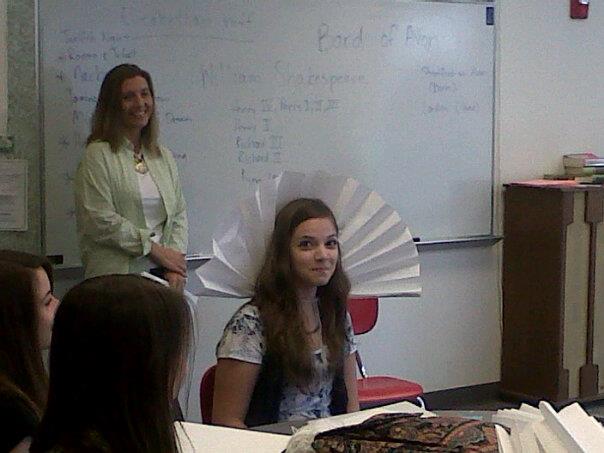
Hannah makes an Elizabethan collar
Take a look at the fruit of presenting living ideas to our children, especially those that provide an ethics framework for them:

This is how he [the poet Thomas Traherne] deals with Geography, for example:––


"When I heard of any new kingdom beyond the seas the light and glory of it entered into me. It rose up within me and I was enlarged by the whole. I entered into it, I saw its commodities, springs, meadows, inhabitants and became possessor of that new room as if it had been prepared for me so much was I magnified and delighted in it. When the Bible was read my spirit was present in other ages. I saw the light and splendour of them, the land of Canaan, the Israelites entering into it, the ancient glory of the Amorites, their peace and riches, their cities, houses, vines and fig trees . . . I saw and felt all in such a lively manner as if there had been no other way to those places but in spirit only. Without changing place in myself I could behold and enjoy all those. Anything when it was proposed though it was a thousand years ago being always present before me."

 
And in the words of Comenius: "The proper education of the young does not consist in stuffing their heads with a mass of words, sentences, and ideas dragged together out of various authors, but in opening up their understanding to the outer world, so that a living stream may flow from their own minds, just as leaves, flowers, and fruit spring from the bud on a tree."

Here are some concrete ways to show that you value a child:

1. When speaking to a small child, stoop down and look him in the eye directly. Let kindness (but firmness) blaze through your eyes to his so that your shared humanity is recognized but your distinct authority is also noted. 


2. Give the child your full attention. So many times we're reading a text, cooking dinner, running errands, or otherwise preoccupied when that moment comes that a child is ready to open up his heart and soul to us. Each precious child deserves our full and undivided attention.


3. Bring your children (students) alongside you as you learn and grow in knowledge.Your appetite and curiosity will be contagious.


4. Be careful what you say. Choose your words carefully because not only are children sponges who will pick up the words and phrases you use and run with them. They are also delicate creatures who can easily misunderstand or misinterpret the words you say. And generally speaking, they will twist their hearts into a knot, worrying over what you meant when you said thus and so. Be very clear. As Richard Mitchell said in The Underground Grammarian,
"We do the business of the mind in language." Children are born with alert minds, so please choose your words carefully. 


Tommy, second from the right, behind his sister
You may be wondering why I titled this post "Children are born persons. So what?" Well, there's a story behind the catch phrase, "So what?" My nephew Tommy has had quite a struggle in this life. He was born with a congenital heart defect and hydrocephalus. He had three or four heart surgeries and at least two brain surgeries before the age of two. He wasn't expected to live, but he surprised us all by surviving! And he is greatly treasured.  

Tommy doesn't talk much. He CAN talk, but he doesn't have a strong grasp of vocabulary and finds it difficult to grab the words he needs to communicate his thoughts and feelings to us. He struggles with typing, too, but desperately wants to be a part of our lives via social media. One of Tommy's favorite phrases is "So what?" He doesn't mean it in the typical sense (sarcasm, a challenge to whatever sentence came before). What he means is "So what does this mean for me?" He's trying to tell us he needs an authentic way to relate the knowledge to what his soul cares about. Tommy craves authenticity. He wants to know why what I'm telling him is important. He lacks much of what we consider the normal ability to evaluate, intuit, or perceive truth. So he takes everyone at their word. Interacting with Tommy is, in a way, a holy experience because he is so totally and completely open and raw and able to be harmed by the words we speak without knowing any harm was on its way.

Thomas Traherne's words ring true here:

"Our Saviour's meaning, when He said, He must be born again and become a little child that will enter into the Kingdom of Heaven is deeper far than is generally believed. It is not only in a careless reliance upon Divine Providence, that we are to become little children, or in the feebleness and shortness of our anger and simplicity of our passions, but in the peace and purity of all our soul. Which purity also is a deeper thing than is commonly apprehended. For we must disrobe ourselves of all false colours, and unclothe our souls of evil habits; all our thoughts must be infant-like and clear; the powers of our soul free from the leaven of this world, and disentangled from men's conceits and customs."(http://www.spiritofprayer.com/03century.php)

May we all disrobe ourselves of false colors and unclothe our souls of evil habits; all our thoughts becoming infant-like and clear, the powers of our souls free from the leaven of this world. Is there someone you need to talk to today? A child you scolded impatiently or a friend you disrespected? A family member who made you so angry that you gave them "the silent treatment" for ten years? It's never too late. Call them! We are all persons, endowed supernaturally with great value. Some are diamonds in the rough while others have had their rough edges smoothed, but we are all of great value! Go find that pearl of great price that you have inadvertently marred and apply the salve of human kindness. Even if they don't choose to accept it, you will have expressed an important truth to them and to yourself. You will have said, "You are a person of great worth and potential." The rest is up to God.


"We are all citizens of one world, we are all of one blood.  To hate a man because he was born in another country, because he speaks a different language, or because he takes a different view on this subject or that, is a great folly.  Desist, I implore you, for we are all equally human....  Let us have but one end in view, the welfare of humanity; and let us put aside all selfishness in considerations of language, nationality, or religion." John Amos Comenius

http://www.spiritofprayer.com/03century.php
http://www.amblesideonline.org/CM/6_1_02.html
http://everywakinghour.blogspot.com/2008/11/children-are-born-persons.html
http://www.amblesideonline.org/CM/20Principles.html